Monday, October 29, 2012

Wishing You a Safe and Happy Hurricane


In reading my friends Facebook posts today, I noticed that only teachers are excited about the Hurricane Days.  Parents with other jobs are less than enthusiastic about the prospect of two days off from school, with the possibility of no power.  So as a public service, I have decided to provide you with a list of low-tech, literacy activities to engage kids for the duration of Hurricane Sandy. 

Admittedly, you might want to save your flashlight batteries, but if you've been watching the news for the past week, you've been warned to stock up.  So you can build a tent from blankets and chairs and read some good books by flashlight.  The best picture books to read in a blanket tent are Owl Moon by Jane Yolen and Brave Irene by William Steig.  For big kids, I’d recommend Hatchet by Gary Paulsen and The Underneath by Eva Ibbotson.  Some other options are books about storms.  I love Thundercake by Patricia Polacco, and if you haven’t lost power yet, Polacco includes her grandmother’s recipe at the back of the book.  It’s beyond my abilities in the kitchen, but I have a friend who made it for her class, and it was delicious.  Tomatoes are the secret ingredient.  There’s also Cloudy with a Chance of Meatballs by Judi Barrett.  You might steer clear of non-fiction until the storm is over, but Gail Gibbons, Seymour Simon, National Geographic and DK Readers write great non-fiction about storms and hurricanes, in particular.  

Another option is to raid the Halloween candy early.  (Let’s face it; Halloween is going to be a wash, anyway.)  Hide individual pieces around the house and write clues or a draw a treasure map for your kids to follow and find them.  If they're older, it’s even better, because they can write the clues themselves and maybe you can get a load of laundry done.  There are tons of books about treasure hunting ranging from Dora the Explorer to Treasure Island.  My niece loves My Mermaid Counting Book by Sue Hendra, where she can count the sea creatures and find a treasure on each page.  
 
You can play the alphabet game with hurricane words.  If your child is in fourth grade, A is for anemometer and B is for barometer (It’s fourth grade curriculum.)  If they’re younger, A is for all the lights went out and B is for blowing wind.  Scattegories is another option.  Even if you don’t have the game, you can make up your own categories and choose a letter of the alphabet.  I found a Scattegories app for my phone last summer, and my cousins and I turned it into a drinking game. 

My last suggestion is the silliest, but when my sister and I were little, it was our favorite.  My mom made flashcards with sight words for us.  (She was a teacher, too.)  She taught us one a day.  Then when Dad came home at night, he’d quiz us on the flashcards.  When we got the words right, we took them and built a circle on the floor.  When the circle was complete, we pretended it was a swimming pool, jumped in and “swam” around.  We've played the same game with my niece, my mom used it with her kindergartners, and I even play a version with my 4th and 5th graders.  They roll dice, and read the number of flashcards they roll.  The person who reads the most . . . wins.  For some reason, kids love it.  Happy Hurricane Days and stay safe.
 
Books to Read During a Hurricane
Owl Moon by Jane Yolen
Brave Irene by William Steig
Hatchet by Gary Paulsen
The Underneath by Eva Ibbotson
Thundercake by Patricia Polacco
Cloudy with a Chance of Meatballs by Judi Barrett
Storms by Seymour Simon
Hurricanes by Seymour Simon
National Geographic Readers: Storms by Miriam Goin
Hurricanes! By Gail Gibbons
DK Eyewitness Books: Hurricane and Tornado by Jack Challoner
The Magic School Bus: Inside a Hurricane by Joanna Cole
The Magic School Bus: Kicks up a Storm by Nancy White
Judy Moody and Stink: The Mad, Mad, Mad, Mad Treasure Hunt by Megan McDonald
Mayflower Treasure Hunt (A-Z Mysteries) by Ron Roy
Skippyjon Jones and the Treasure Hunt by Judy Schachner
Dora’s Treasure Hunt by Alison Inches
Treasure Island by Robert Louis Stevenson
My Mermaid Counting Book by Sue Hendra

Monday, October 22, 2012

Fluency Finds


This semester I’m taking a class on a reading assessment I’ve been giving for the last 6 years.  Since I changed counties last year, I have to be retrained.  Unfortunately, none of the homework assignments are the same, so I can’t even cheat.  This week my homework is to write an informational letter to parents about fluency.  So I thought I’d focus on fluency this week, and turn in my blog. 

Fluency is the way a child sounds when she reads.  It includes reading words correctly, quickly, and with phrasing and expression.  It’s the bridge between decoding words and understanding the story.  When you think about what your brain does as you read, your eyes are moving 3-4 words ahead of your brain as you decode the words.  You’re also attending to punctuation and grouping words together into phrases that make sense, and all the while your brain is turning the visual information into a meaningful story.  That seems like a lot to teach our kids, but not if we read with them.

I’ve spent the last couple weekends, with two 2-year-olds.  My niece “reads” in a silly, high pitched voice, but she imitates the inflections we use when we read.  My friend’s son reads the last word of every line in The Cat and the Hat and never misses the rhythm.  These kids have been read to since birth, and they are already showing signs of early literacy.  Every time a child asks you to reread a favorite book, you’re increasing her fluency.

There are also some books designed to build fluency in kids.  Poetry and rhyming books are perfect examples.  My favorite children’s poets now are Shel Silverstein, Kali Dakos and Jack Prelutsky, but as kids, my sister and I loved Dr. Suess’s Oh, Say, Can You Say?  It’s a book of tongue twisters that made our parents crazy, but brought us endless joy.  Mary Ann Hoberman has a series called You Read to Me, I’ll Read to You.  They’re collections of stories and poems designed to be read aloud by two people.  Kids love them.  Books written like comics with speech bubbles also lend themselves to fluency work.  It encourages kids to read the way they talk.  I like Yo! Yes! by Chris Raschka, Z is for Moose by Kelly Bingham, and the Elephant and Piggie series by Mo Willems.  Also by Willems is Knuffle Bunny: A Cautionary Tale.  It’s about the dangers of taking your favorite stuffed animal every where you go, and it’s written with a short phrase on each page.  And if you like the first one, you can enjoy the whole trilogy: Knuffle Bunny, Too and Knuffle Bunny, FreeNo, David! by David Shannon is another great option, because “No, David,” is repeated on each page with varying degrees of passion.  Reading to, by and with our children is the best way to build fluency. 
 
Books for Building Fluency
You Read to Me, I’ll Read to You by Mary Ann Hoberman
Yo! Yes! by Chris Raschka
Z is for Moose by Kelly Bingham
The Elephant and Piggie Series by Mo Willems
The Pigeon Series by Mo Willems
The Knuffle Bunny Series by Mo Willems
No, David! by David Shannon
Where the Sidewalk Ends by Shel Silverstein
If You’re Not Here Please Raise Your Hand by Kali Dakos
A Pizza the Size of the Sun by Jack Pretulsky
The Cat and the Hat by Dr. Suess
Oh, Say, Can You Say? By Dr. Suess


Sunday, October 14, 2012

Costumes, Candy and Books!


Halloween will be here in two weeks, and kids everywhere are overly excited.  It was never my thing.  The scariest costume I ever wore was Peter Pan – I carried a sword.  On the other hand, my students always seem surprised that school is not canceled for Halloween.  For kids it is a very real holiday, and it makes them want to read scary books.  My favorite elementary school librarian told me that a fourth grader asked for a scary book on Friday, and she suggested Acid Rain (a chilling topic).  We try to keep things tame in elementary school, and I've never liked horror as a genre, but kids do.  So I try to make an exception for Halloween.

For little kids, Halloween is a great time for counting books.  Perhaps publishers see it as practice for candy counting.  Any of the many versions of Five Little Pumpkins are good choices, and my niece has the sequel, Five Little Ghosts.  Both are rhyming books that count backwards from five. There’s also Halloween 123s by Patti Reeder Eubank and Too Many Monsters by Robert Neubecker.  Both books count up to ten.  For our middle readers, all of our favorite characters have a Halloween book.  Biscuit, Arthur, Franklin, and Amelia Bedelia all celebrate this scariest of holidays, as do Fancy Nancy, Junie B., Cam Jansen and Jigsaw Jones.  For readers who want something creepier, Marion Dane Bauer has a series of ghost stories that are geared towards second and third graders. 
   
At a time when vampires, werewolves and witches are everyday fare, our big kids want really terrifying Halloween books.  There are plenty of titles that will give them the shivers without, exposing them to the mature themes of young adult novels.  The Graveyard Book by Neil Gaiman is about a boy who is raised by ghosts.  It’s an unsettling story, but well written and clever.  My students are fans of Mary Downing Hahn, whose ghost stories provide the necessary chills, and I love Chris VanAllsburg’s The Stranger and The Widow’s Broom.  The first is about a mysterious stranger whose presence at a farm seems to keep winter from coming.  The latter is the story of a witch’s discarded broom, and it’s unending and unnerving usefulness.  Roald Dahl’s The Witches was always my October read aloud, because few things are more frightening than a group of witches plotting to turn children into mice.  As we busily gather costume accessories and candy over the next two weeks, take some time to share a good book.  Happy Halloween!
 
Halloween Books
Five Little Pumpkins by Dan Yaccarino
Five Little Pumpkins by Iris Van Rynbach
Five Little Pumpkins by Ben Mantle
Five Little Ghosts by William Boniface
Halloween 123s by Patti Reeder Eubank
Too Many Monsters by Robert Neubecker
Happy Halloween, Biscuit by Alyssa Satin Capucilli
Arthur’s Halloween by Marc Brown
Franklin’s Halloween by Paulette Bourgeois
Happy Haunting, Amelia Bedelia by Herman Parish
Fancy Nancy: Halloween . . .or Bust! by Jane O’Connor
Junie B., First Grader: Boo . . . And I Mean It! by Barbara Park
Cam Jansen and the Mystery at the Haunted House by David A. Adler
Jigsaw Jones and the Case of the Groaning Ghost by James Preller
The Blue Ghost by Marion Dane Bauer
The Graveyard Book by Neil Gaiman
All the Lovely Bad Ones by Mary Downing Hahn
The Stranger by Chris VanAllsburg
The Widow’s Broom by Chris VanAllsburg
The Witches by Roald Dahl


Monday, October 1, 2012

Make New Friends


In the first weeks of school, teachers spend a lot of time teaching friendship.  Consequently, we read a lot of books about making friends, sharing and cooperation.  They’re lessons that kids need, and a book can be a painless way to teach them.  I've had an opportunity to read some of my favorites in the last few weeks, so I thought I’d share some.

Duck and Goose by Tad Hills has been one of my favorites since it’s publication in 2006.  Duck and Goose find a ball, but mistake it for an egg.  While arguing over whose egg it is and determining the best way to care for it, they become friends.  My niece loves The Pigeon Finds a Hot Dog by Mo Willems.  It’s about what happens when Pigeon is faced with the choice of enjoying a hot dog all by himself or sharing it with a friend.  As you may know, Pigeon does not have a lot of self control and can be pretty impulsive, but he makes a good choice in the end.  So he’s a good model for Bella, who, like all two-year-olds, hates to share.  Both are very silly books with great messages.  Enemy Pie is another excellent choice.  A dad helps his son make enemy pie, ostensibly to get rid of the new kid who seems to be stealing his best friend.  I’d also recommend Yo! Yes! by Chris Raschka.  In about 15 words, it teaches us how to make a friend.  It’s also great for teaching reading with expression and attending to punctuation.

If you want something a little deeper, there’s The Other Side by Jacqueline Woodson.  Anna and Clover manage to become friends despite the fence that segregates their town.  Almost all of Kevin Henkes’ books deal with friendship, especially Chrysanthemum, and of course we have the classic book about friendship and sharing, The Rainbow Fish by Marcus Pfister.  The Rainbow Fish discovers that when you don't share, you don’t make many friends.  Making and keeping friends are issues that all kids deal with.  Fortunately, there are hundreds of great book choices to help. 
 
Books about Friendship
Duck and Goose by Tad Hills
The Pigeon Finds a Hot Dog by Mo Willems
Elephant and Piggie by Mo Willems
Enemy Pie by Derek Munson
Yo! Yes! by Chris Raschka
The Other Side by Jacqueline Woodson
Chrysanthemum by Kevin Henkes
The Recess Queen by Alexis O’Neill
The Rainbow Fish by Marcus Pfister
Frog and Toad by Arnold Lobel
Big Dog . . . Little Dog by P.D. Eastman
A Flea Story by Leo Lioni

Sunday, September 23, 2012

The National Book Festival


Every year the National Book Festival falls on the weekend of my birthday.  I’ve spent several birthdays on the National Mall listening to authors talk about their craft and buying books.  The Maryland Renaissance Festival also coincides with my birthday, but I seem to have out grown wearing puffy shirts and ogling carnies in period dress.  This year three of my favorite children’s authors were featured guests, so I’m dedicating this week to Lois Lowry, Jerry Spinelli and Avi.  

All three of them have new books coming out this fall, and have written some of the all time best.  Of the three, I’ve known Lowry the longest.  Her Anastasia series was one of my favorites in fourth grade, and I still treasure my signed copy of Anastasia, Ask Your Analyst.  Unfortunately, I’ve found that today’s kids aren’t as enamored of the slightly nerdy, imaginative heroine to whom I related.  She’s better known for her Newberry Award winners, Number the Stars a beautifully written book about the Holocaust and The Giver, which started the dystopian society craze that seems to be the genre of choice for most tweens.  The fourth and final book in The Giver series, Son, is being released this fall. 

Spinelli is a very different writer, and I first discovered him in my student teaching when I read his classic, Maniac Magee.  Maniac is an orphan, who somehow manages to bring together the black and white sides of a segregated community.  There are so many layers to the book that it quickly became one of my favorite literature studies.  The Library Card is one of his more obscure books, but I love it.  It’s a collection of four short stories, each about a different kid who is saved by a library card.  Loser and Stargirl came out within a year of each other and deal with the same themes of bullying and fitting in.  Loser is geared towards upper elementary kids and Stargirl for middle and high-schoolers.  I read Loser to my class every year, because they needed to hear the message that it’s okay to be yourself.  His new book is called Jake and Lily.  I’m still on the library waiting list for it, but I’ve read the reviews and excerpts.  I’m sure it will be as good as his others.  It’s about twins with a strong and mysterious mental connection.  
Through most of middle school, Avi’s book The True Confessions of Charlotte Doyle was my absolute favorite book.  It still ranks pretty high on the list, and the copy I keep in my classroom is much loved.  It’s about Charlotte, who is traveling across the Atlantic in 1832 to join her family in Rhode Island when she gets caught up drama of a mutinous crew.  Adventure and a strong female lead, what 13 year old wouldn’t love it?  Many of Avi’s books are historical adventure stories, like Crispin, Cross of Lead and The Fighting Ground.  The first is about a peasant boy in medieval England trying to escape death for a crime he didn’t commit, and the latter is about a young boy in Revolutionary America, who sneaks off to join the fight.  The entire book takes place over the course of 24 hours.  However, Avi is a varied and prolific writer.  He’s also written the Poppy series about some field mice, forever trying to avoid their predators.  It’s an adventure tale and discourse on the food web rolled together in one.  He’s written over 50 books, and I’ve yet to read one I haven’t liked. 
 
Books by Lois Lowry
Anastasia Krupnik
Number the Stars (Newberry Award Winner)
The Giver (Newberry Award Winner)
Gathering Blue
Gossamer
Messenger
Son (Comes out in October)

Books by Jerry Spinelli
Maniac Magee (Newberry Award Winner)
Loser
Stargirl
Fourth Grade Rats
The Library Card
Eggs
Jake and Lilly


Books by Avi
The True Confessions of Charlotte Doyle (Newberry Honor)
Crispin, Cross of Lead (Newberry Award Winner)
The Fighting Ground
Poppy
The Secret School
Midnight Magic
Iron Thunder
Sophia’s War (Comes out this month)

Sunday, September 16, 2012

A is Not for Aardvark


On the second day of school, I met a kindergartener who didn’t know his name.  It wasn’t that he couldn’t spell his name; he didn’t know his first or last name.  When I asked, he said, “Tito,” but Tito is a term of endearment.  It wouldn’t be the name he was registered under.  Eventually, we determined that his name was Alejandro and got him to the correct classroom.  (We do this by asking the older children on the bus if they know this kid.  Believe it or not, this happens often enough that there is procedure in place to fix it.)  I’ve been teaching in Title 1 schools for 13 years, and I still can’t get used to the fact that our kindergartners come to school so ill prepared.  Alejandro probably doesn’t know the alphabet and has minimal experience with books.  School is going to be much harder for him, than for my friend’s son.  When I told Peyton that the best part of kindergarten was learning to read, he responded, “I already know how to read.”  I checked back in on Alejandro last week, and it turns out he’s a bright kid and is learning like a sponge.  Unfortunately, statistics show that Peyton and Alejandro’s different experiences in their first 5 years will likely follow them for life.  That’s scary fact, and one that could have been remedied with a couple of books, particularly ABC books.

ABC books are the prefect educational tool.  Besides teaching the alphabet, they teach phonics, vocabulary, and concepts about print; and the best ones are entertaining too.  Some of my favorites are Click Clack, Quackity Quack by Doreen Cronin, B is for Bear by Roger Priddy and Eric Carle’s ABC.  Truly any ABC book is good, but some are better than others.  Look for lower case letters and words with clear beginning letter sounds, not blends.  D should be for dog, not drum, s for sun, not snake.  For kids who are just learning their letter sounds, blends are confusing.  I also like short vowels sounds, but I’m happy as long as the vowels sounds aren’t complex.  Look for a is for apple, not aardvark, and o is for octopus, not owl.  With c and g, we want hard sounds; c is for cat, not circle and g is for golf, not giraffe.  I’ve never found a perfect alphabet book, but these rules guide me towards the better ones.  Andrew Zuckerman’s Creature ABC has great photos of animals and both the uppercase and lowercase letters.  It does use elephant for e.  It’s not my favorite example, because elephant sounds like it starts with l.  Black and White Rabbit’s ABC by Alan Baker is also an excellent choice.  Along with being an alphabet book, it also tells the story as Rabbit paints a picture. 

ABC books are not just for little kids either.  There are some clever ones that big kids will enjoy as well.  Most elementary kids need to continue practicing alphabetical order even after kindergarten.  I love Q is for Duck by Mary Elting (because ducks quack).  My fourth graders devoured the riddles in the book.  Jerry Pallotta has a series of animal ABC books that focus on ocean animals, mammals, insects, etc.  They tend to be difficult reads, but they are full of interesting animal facts.  Some alphabet books have beautiful pictures, and can be enjoyed by kids of any age.  The Handmade Alphabet by Laura Rankin, teaches the American Sign Language alphabet.  Alphabet City by Stephen Johnson finds the letters of the alphabet in common city sights, and Chris VanAllsburg created a dramatic story for each letter in his detailed illustrations of The Z was Zapped.  When it comes down to it, no matter what words the author chooses for a letter, an ABC book is always a good choice.  
 
Click Clack, Quackity Quack by Doreen Cronin
B is for Bear by Roger Priddy
Eric Carle’s ABC by Eric Carle
Creature ABC by Andrew Zuckerman
Black and White Rabbit’s ABC by Alan Baker
Q is for Duck by Mary Elting
The Underwater Alphabet Book by Jerry Pallotta
The Icky Bug Alphabet Book by Jerry Pallotta
The Bird Alphabet Book by Jerry Pallotta
The Handmade Alphabet by Laura Rankin
Alphabet City by Stephen Johnson
The Z was Zapped by Chris VanAllsburg
The Crazy Alphabet by Lynn Cox
The Cow is Mooing Anyhow by Laura Geringer
Dr. Suess’s ABC by Dr. Suess
Z is for Moose by Kelly Bingham

Sunday, September 9, 2012

Chapter Books is Not a Genre


There are two things kids say that make me crazy.  When discussing who will be racing whom on the playground, “I’ll verse you at recess;” and when asked what kind of books they like to read, “Chapter books.”  I have been waging a long and futile war to convince elementary students that verse is a preposition, not a verb, and chapter books is not a genre.  When kids tell me chapter books are their favorites, it’s usually a sign of limited reading experiences.  Sophisticated readers answer with actual genres, authors or series.  I’ve learned that a kid who asks for chapter books, feels like the books she is reading are either too easy or look too easy.  They want to look like a more sophisticated reader, and we have books to help them.

I have friend whose five year old daughter is a strong reader, but she’s still little.  She’s obviously not ready for novels, but she wants to read books like the big kids.  There are a couple of publishers that specialize in this level.  Look for I Can Read, Kids Can Read, and Ready to Read.  The classic choices for these kids are Frog and Toad by Arnold Lobel and Henry and Mudge by Cynthia Rylant.  They’re everyone’s first chapter books.  The lessons about friendship are simple, but relevant for young kids.  Then there’s Fox and His Friends by Edward Marshall.  Fox is a goofy troublemaker, but some of the language is old fashioned and unfamiliar to kids.  Several more difficult series have junior versions, like the Young Cam Jansen and A is for Amber, the easy Amber Browns.  These are nice, because they look harder on the outside, but are easy on the inside.  The books retain the humor and plot of the originals, just at an easier reading level.  Also some of our favorite characters from picture books have graduated to chapter books.  Look for the series about Arthur, the aardvark, and Amelia Bedelia.  For mystery lovers, there’s Nate the Great, another great boy detective.  I’m a fan of Fancy Nancy, a glamorous, young protagonist, and Robert books, but then I always did like the naughty ones. 
 
For older kids who struggle in reading, easy chapter books like this can be a saving grace.  They look respectable on the outside, but they have strong picture clues and the reading level is accessible.  Kids who are reading on this level are usually just starting to become independent readers.  When these kids get stuck on a difficult word, we need to prompt them to think about the story first.  We want them thinking about what would make sense in the sentence.  Suggest they try rereading the sentence; it’s the most powerful strategy a reader can use when she gets stuck.  If that doesn’t work, we want them looking for familiar chunks of words.  We want them to see the “and” in “grand” or the “ing” and “ed” at the end of a verb.  These kids are moving beyond “sounding it out.”  Instead we ask them to “chunk it,” “take the word apart,” or “look for the little word inside the big word.”  But most importantly, we want them to enjoy the “chapter books!”
 
Easy Chapter Books
Frog and Toad are Friends by Arnold Lobel
Fox and His Friends by Edward Marshall
The Young Cam Jansen by David A. Adler
Second Grade Rules, Amber Brown by Paula Danzinger
Arthur Chapter Books by Marc Brown
Amelia Bedelia Chapter Books by Herman Parish
Henry and Mudge by Cynthia Rylant
Nate the Great by Marjorie Weinman Sharmat
Clifford Big Red Chapter Books by Gail Herman
Mouse Tales by Arnold Lobel
Robert and the Sneaker Snobs by Barbara Seuling
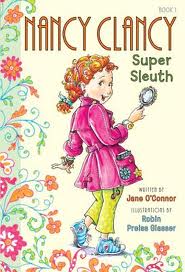
Fancy Nancy: Nancy Clancy, Super Sleuth by Jane O’Connor
Just Grace by Charise Mericle Harper